Background Removal at Scale: How Brands Edit 10,000+ Images Monthly

If you look at a modern eCommerce website, it may seem simple. Clean white backgrounds. Perfectly centered products. Consistent shadows.
But behind those images is an enormous production machine. eCommerce brands process thousands of product photos monthly. They must meet strict image standards.
That means one thing: background removal at scale. For many businesses like CPI, editing 10,000 or more images every month is normal.
It’s not just about removing the background. The real challenge is to do it quickly, consistently, and without losing quality.
Let’s break down how large brands actually handle this workload.
The Scale of Image Editing in Modern eCommerce
Most people underestimate how many product images an online business actually needs.
Consider a typical mid-sized fashion retailer.
They may launch 400–500 products per month. But each product rarely uses a single image.
Instead, a product listing might include:
- front view
- back view
- close-up details
- side view
- lifestyle shot
- packaging shot
That quickly multiplies the image count. Here’s a realistic example.
And this is just a single brand. Large marketplaces process millions of images every month.
Without efficient background removal, these images would never reach the website on time.
Why Background Removal Matters So Much
At first glance, removing a background might seem like a small editing task. In reality, it’s the foundation of product photography.
Most eCommerce platforms require specific image standards. For example, marketplaces often require:
- pure white backgrounds
- centered products
- no distractions
- consistent shadows
If the background isn’t clean, the image may be rejected. Also, inconsistent images can harm a brand’s reputation.
Consumers assess product quality through visuals. If images appear amateurish, customers often view the product as low quality.
Good background removal does three critical things.
1. Creates Visual Consistency
A clean background makes every product look part of the same catalog. This consistency builds trust.
2. Improves Conversion Rates
Research has found that using clean product images can greatly improve click-through rates and conversions. When shoppers can see a product clearly, they are more likely to make a purchase.
3. Meets Marketplace Requirements
Platforms like Amazon, Walmart, and Shopify often have strict image guidelines. Background removal helps brands follow these rules.
The Biggest Challenges of Editing Thousands of Images
Editing a few photos is easy. Editing 10,000 photos every month is a different story. Several problems come up right away.
Consistency Across Thousands of Images
Imagine a catalog where every product image looks slightly different. Some have gray backgrounds, some have visible edges. And some have no shadows.
That destroys brand consistency. Large brands must ensure every image follows the same visual standard.
Complex Product Edges
Some products are simple. A coffee mug is easy to isolate. But other products are extremely difficult. Examples include:
- hair and fur
- transparent fabrics
- lace clothing
- jewelry chains
- glass products
These objects require precision masking and manual refinement. AI tools still struggle with many of these details.
Turnaround Time Pressure
Product launches depend on image production. If editing is slow, products cannot go live on time. This can delay:
- marketing campaigns
- seasonal launches
- marketplace listings
Brands often operate under tight deadlines.
File Management Chaos
High-volume image editing involves massive file organization. A single product shoot may include:
- RAW camera files
- PSD working files
- multiple export versions
Without structured workflows, managing these files becomes overwhelming.
How Large Brands Actually Process 10,000+ Images
So how do companies manage this scale? The secret isn’t a single tool.
It’s a production system. Large brands treat image editing like a manufacturing pipeline.
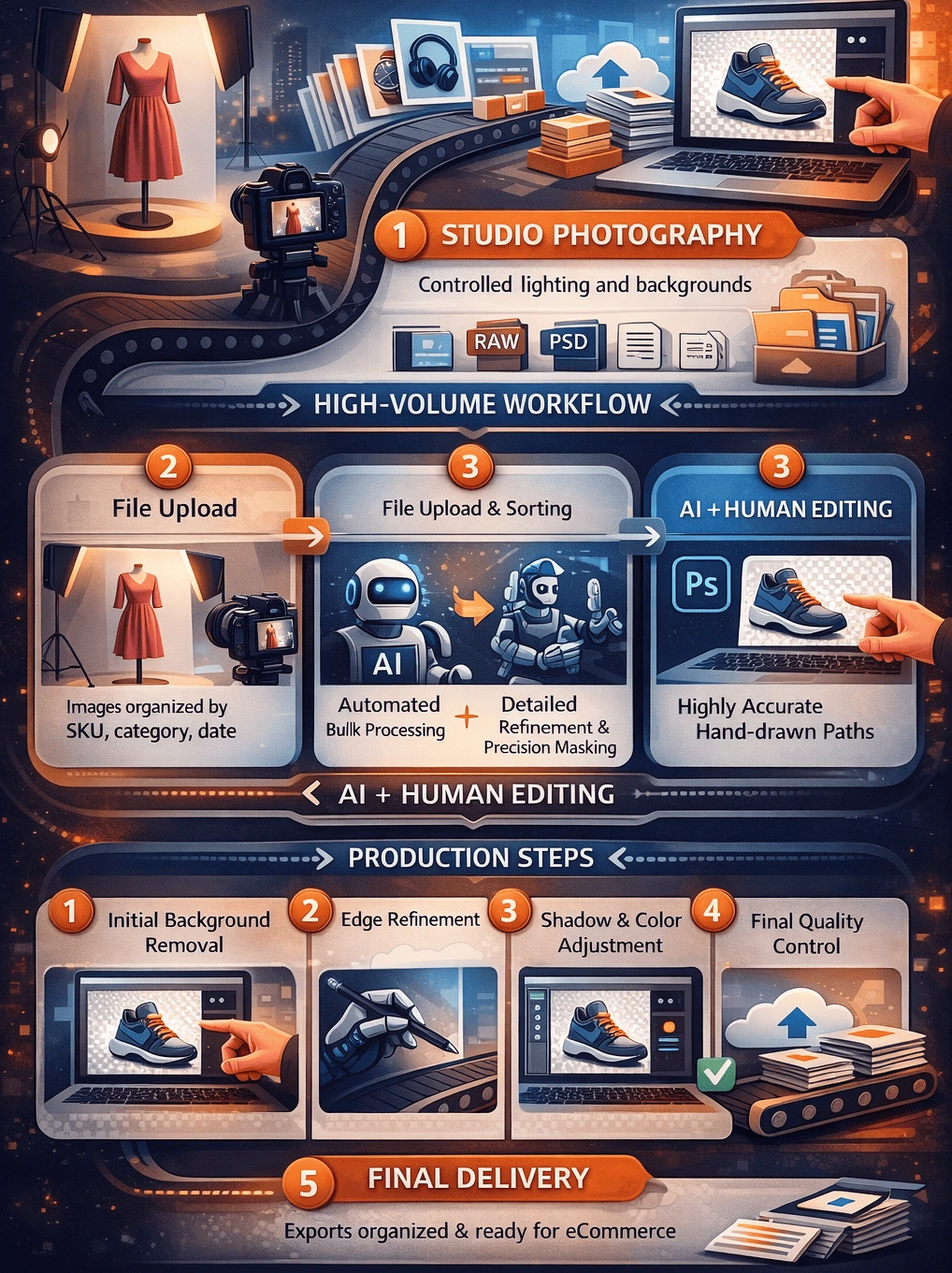
Step 1: Studio Photography with Controlled Lighting
The process begins during the photo shoot. Professional studios use controlled lighting and neutral backgrounds.
This makes background removal easier later. Typical setups include:
- seamless white backdrops
- consistent lighting angles
- fixed camera positions
By standardizing the shoot, editors can work faster.
Step 2: File Organization and Asset Management
After the shoot, images are uploaded into structured folders. Most companies organize files by:
- product SKU
- category
- shoot date
- photographer
Some brands also use Digital Asset Management (DAM) systems to track thousands of images. This ensures editors always work with the correct files.
Step 3: Background Removal Production
This is where the real editing begins. There are three main approaches brands use.
AI Background Removal
AI tools can automatically detect objects and remove backgrounds. Benefits include:
- very fast processing
- batch editing capabilities
- lower cost per image
However, AI has limitations. It often struggles with:
- hair
- transparent objects
- reflective surfaces
For simple products, AI works well. For complex products, it still needs human help.
Manual Clipping Path Editing
This is the traditional approach. Editors use tools like the pen tool to draw precise paths around products.
Advantages:
- extremely accurate edges
- perfect for complex shapes
- full control over masking
The downside is speed. Manual editing is slower than AI. But for high-quality catalogs, it remains essential.
Hybrid AI + Human Workflow
Today, many brands use a hybrid approach. AI handles the first step. Human editors refine the results. This workflow combines:
- AI speed
- human precision
It’s currently the most efficient way to process large image volumes.
The Production Workflow Used by Editing Teams
High-volume editing teams follow structured pipelines. Here’s a typical workflow.
- Image ingestion and sorting
- Initial background removal
- Edge refinement
- Shadow creation
- Color correction
- Quality control
- Export and delivery
Each stage may be handled by a different specialist. This assembly-line approach increases efficiency.
Technology Behind High-Volume Image Editing
Modern image production relies heavily on technology. But technology alone isn’t enough. Let’s look at what tools brands use.
AI Segmentation Tools
Advanced AI models can identify objects in images and generate masks automatically. These tools are ideal for:
- simple products
- large batch processing
- quick background swaps
They dramatically reduce editing time. But AI still produces errors. Edges may appear rough or unnatural. That’s why human editors remain important.
Human Retouching Expertise
Professional editors refine AI results. They handle tasks such as:
- edge cleanup
- hair masking
- shadow reconstruction
- product color correction
Human judgment ensures the final image looks natural.
Quality Control Systems
When editing thousands of images, mistakes are inevitable. That’s why large brands implement strict quality control processes.
A typical QC system includes multiple layers.
Level 1: Editor Self-Check
Editors review their own work before submission.
Level 2: Team Quality Review
A separate reviewer checks images for issues.
Level 3: Final Client Approval
The brand verifies the final images before publishing. Common QC issues include:
- jagged edges
- halo effects
- inconsistent shadows
- color mismatches
Without proper QC, these errors quickly multiply across large catalogs.
The Cost of Poor Background Removal
Bad image editing isn’t just a visual problem. It directly impacts revenue. Here’s how.
Lower Conversion Rates
Customers rely on product photos when shopping online. If images look unnatural or poorly edited, shoppers are less likely to buy. Clean product images usually lead to higher engagement and conversion rates.
Product Returns
Inaccurate images can misrepresent product colors or shapes, leading to disappointed customers and more returns. This can be expensive for online retailers because returns cost them money.
Marketplace Rejections
Platforms like Amazon enforce strict image standards. Images that fail these guidelines may be rejected. That delays product listings and hurts sales momentum.
Why Many Brands Outsource Background Removal
Large brands rarely edit all their images in-house. Instead, many rely on specialized editing providers.
There are several reasons for this.
Cost Efficiency
Having a big team of editors in-house can be pricey. Outsourcing is a better option because companies only pay for what they actually need.
Scalability
Image volume fluctuates. One month may require 2,000 edits. Another month may require 15,000. External providers can scale quickly.
Faster Turnaround
Professional editing studios operate around the clock. This enables fast delivery times, even for large batches.
Choosing the Right Image Editing Partner
If a brand plans to outsource background removal, it’s crucial to choose the right partner. Here are the key factors to consider.
Production Capacity: Can the provider handle large volumes consistently?
Quality Standards: Do they maintain strict quality control processes?
Turnaround Time: Fast delivery is essential for product launches.
File Delivery Systems: Efficient upload and download systems reduce workflow delays.
Trial Options: Many professional providers offer free trial edits so brands can evaluate quality.
The Future of Background Removal at Scale
Image editing technology continues to evolve. Several trends are shaping the future.
AI-Assisted Editing Pipelines
AI will handle more initial tasks, allowing editors to focus on refinement. This will significantly increase production speed.
Direct Integration with eCommerce Platforms
In the future, systems might automatically move images from the studio to the product page. Editing workflows will also become more automated.
Smarter Quality Control
Machine learning may detect editing errors automatically. This will reduce the need for manual QC checks.
To Conclude
Background removal may look simple. But at scale, it becomes a complex production process.
Top brands editing over 10,000 images monthly use structured workflows and skilled editors. They combine specialized tools with skilled editors for success.
- efficient photography setups
- AI-assisted editing tools
- human retouching expertise
- strong quality control systems
They process large numbers of images while maintaining quality. In eCommerce, speed and quality are key. Mastering image editing helps brands launch products faster and convert more customers.