Hybrid Photo Editing Workflow: How AI and Human Editors Work Better Together
Most people are asking the wrong question. “Should I use AI or human photo editing?”
That’s not the real decision. The real problem is- you need:
- fast turnaround
- consistent quality
- cost control at scale
And if you’ve tried both approaches, you already know what happens.
AI gives you speed. But it breaks on details. Humans give you quality. But they slow everything down.
So you end up stuck in a loop:
- Fixing AI mistakes
- Waiting on manual edits
- Reworking inconsistent outputs
That’s where the shift is happening. Smart brands aren’t choosing sides anymore. They’re combining both.
This is where hybrid photo editing workflows come in.
What Is a Hybrid Photo Editing Workflow?
A hybrid workflow is simple in theory.
You use:
- AI for speed and repetitive tasks
- Humans for precision, judgment, and consistency
But in practice, it’s more structured than that.
Think of it as a production pipeline.
Traditional Workflow (Manual Only)
- Receive images
- Edit manually
- Deliver
Slow. Expensive. Hard to scale.
AI-Only Workflow
- Upload images
- Auto-process
- Download
Fast. Cheap. Risky.
Hybrid Workflow
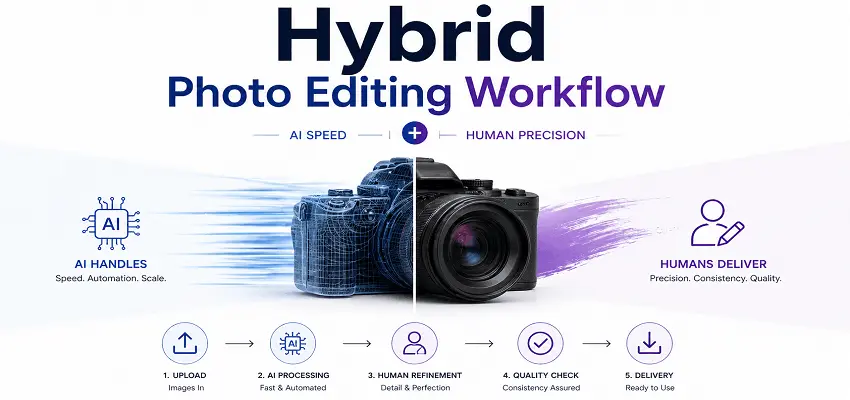
- AI processes images first
- Humans refine and standardize
- Final QA ensures consistency
Balanced. Scalable. Reliable.
That’s the difference.
Why Pure AI Editing Still Fails in Real Workflows
AI tools are impressive. But they’re not reliable enough for production-level work.
Here’s where they break.
1. Edge Detection Isn’t Perfect
AI struggles with:
- Hair
- Fur
- Transparent materials
- Fine product details
You’ll see rough edges, missing sections, or unnatural cutouts.
That’s not acceptable for high-end eCommerce.
2. Inconsistency Across Batches
AI doesn’t think in “sets.” It processes images individually.
That creates problems like:
- Different lighting tones
- Slight color variations
- Background inconsistencies
For a product catalog, this kills brand perception.
3. Product Detail Errors
AI often misinterprets:
- Labels
- Logos
- Packaging text
That leads to distorted or inaccurate visuals.
And if you’re selling online, accuracy matters.
4. Weak Shadow and Reflection Handling
Realistic shadows and reflections are critical. AI often:
- Removes natural shadows
- Creates flat-looking images
- Produces unrealistic lighting
This is especially obvious in:
- Jewelry
- Glass
- Metallic products
5. No Understanding of Brand Standards
AI doesn’t know your:
- brand tone
- preferred lighting
- visual guidelines
It just processes pixels.
That’s why AI-only workflows often need manual correction anyway.
Why Fully Manual Editing Doesn’t Work at Scale
Now let’s look at the other side.
Manual editing is still the gold standard for quality.
But it has serious limitations.
1. Time Per Image Adds Up Fast
Even a skilled editor needs:
- 10–30 minutes per image
If you’re handling 1,000 images:
That’s days or weeks of work.
2. Costs Increase Linearly
More images = more hours More hours = more cost
There’s no efficiency gain.
3. Turnaround Becomes a Bottleneck
In fast-moving industries like eCommerce:
- New products launch daily
- Campaigns change quickly
Manual workflows can’t keep up.
4. Scaling Requires Hiring
To increase output, you need more:
- editors
- management
- coordination
That adds complexity and overhead.
AI vs Human vs Hybrid: A Practical Comparison
Let’s break this down clearly.
Speed
- AI: Seconds per image
- Human: Minutes per image
- Hybrid: Fast with controlled refinement
Quality
- AI: Acceptable for simple images
- Human: High across all cases
- Hybrid: High and consistent
Cost
- AI: Low initial cost
- Human: High labor cost
- Hybrid: Balanced cost efficiency
Scalability
- AI: Highly scalable
- Human: Limited scalability
- Hybrid: Scales without losing quality
Consistency
- AI: Unpredictable
- Human: Good but varies by editor
- Hybrid: Standardized output
Final Insight
If you rely only on AI, you risk quality. If you rely only on humans, you lose speed.
Hybrid workflows solve both problems.
Why Hybrid Workflow Actually Works
This isn’t just theory. It works because it splits tasks correctly.
AI Handles What It’s Good At
- Repetitive tasks
- Bulk processing
- Basic adjustments
This reduces manual workload significantly.
Humans Handle What Matters
- Fine details
- Creative judgment
- Brand consistency
This ensures quality doesn’t drop.
The Result
You get:
- Faster turnaround
- Better consistency
- Lower overall cost
Without compromising output quality.
Step-by-Step Hybrid Photo Editing Workflow
Let’s break down a real workflow.
Step 1: Image Intake and Categorization
Not all images should be treated the same.
You classify them based on:
- Complexity
- Product type
- Editing requirements
This determines how much AI vs human effort is needed.
Step 2: AI-Based Initial Processing
AI does the heavy lifting first.
Typical tasks include:
- Background removal
- Auto masking
- Basic color correction
This step reduces 50–70% of manual effort.
Step 3: Human Refinement
Now humans step in.
They fix:
- Edge accuracy
- Shadow realism
- Texture details
- Imperfections
This is where quality is defined.
Step 4: Brand Consistency Alignment
This step is often ignored.
But it’s critical.
Editors ensure:
- Uniform lighting
- Consistent color tones
- Standardized backgrounds
Across all images.
Step 5: Final Quality Assurance
Before delivery:
- Batch review
- Platform optimization
- Export validation
This ensures no errors reach the client.
Real-World Use Cases
Hybrid workflows are already standard in many industries.
eCommerce
- Bulk product image editing
- Fast catalog updates
Fashion & Apparel
- Consistent lookbooks
- Seasonal collections
Jewelry & Luxury
- Precision editing
- Reflection and texture accuracy
Agencies
- White-label editing
- High-volume delivery
How Hybrid Workflows Improve Business Results
This is where it gets interesting.
1. Faster Time-to-Market
You launch products faster.
That means:
- More sales opportunities
- Faster campaign execution
2. Better Visual Consistency
Consistent images build trust.
And trust increases conversions.
3. Higher Conversion Rates
Better visuals lead to:
- More clicks
- Higher engagement
- Increased sales
4. Reduced Rework
Fewer errors mean:
- Less back-and-forth
- Faster approvals
5. Lower Operational Cost
You reduce manual workload.
Without sacrificing quality.
Common Mistakes in Hybrid Workflows
Most businesses fail here.
1. Skipping Human QA
This defeats the purpose of hybrid.
AI output must be reviewed.
2. Using AI for Complex Images
Not all images should be automated.
High-detail images need more human input.
3. No Defined Workflow
Without structure, results become inconsistent.
4. Ignoring Brand Guidelines
Consistency breaks quickly without standards.
5. Poor Tool Selection
Not all AI tools perform equally.
Choosing the wrong one creates more work.
Tools Used in Hybrid Editing
AI Tools
- Background removal tools
- Auto retouching systems
Manual Tools
- Adobe Photoshop
- Lightroom
Workflow Tools
- Asset management systems
- Task tracking platforms
How to Build a Hybrid Workflow
If you want to implement this, follow these steps.
1. Define Quality Standards
Set clear expectations.
What does a “finished image” look like?
2. Choose AI Tools Carefully
Test multiple tools.
Don’t rely on one blindly.
3. Add Human QA Layers
This is non-negotiable.
4. Create SOPs
Standardize your workflow.
This ensures consistency.
5. Decide Between In-House vs Outsourcing
Outsourcing often gives:
- Faster scaling
- Lower cost
- Better efficiency
The Future of Photo Editing
AI will improve.
But it won’t replace human judgment.
What will happen instead:
- AI will handle more initial work
- Humans will focus on refinement and QA
- Hybrid workflows will become standard
Especially for:
- eCommerce brands
- Agencies
- High-volume production teams
FAQ: Hybrid Photo Editing Workflow
What is hybrid photo editing?
It combines AI automation with human refinement to produce high-quality images efficiently.
Is AI better than human editing?
AI is faster, but humans provide better accuracy and consistency.
Why is hybrid editing effective?
It balances speed and quality, solving the limitations of both approaches.
Does hybrid editing reduce cost?
Yes. It reduces manual workload while maintaining high-quality output.
Who should use hybrid workflows?
Businesses handling bulk images, especially eCommerce brands and agencies.
To Conclude: The Smartest Workflow Wins
Stop thinking in extremes.
It’s not AI vs human. It’s:
How do you combine both to get better results?
Because that’s what matters.
Hybrid workflows give you:
- Speed
- Quality
- Consistency
- Scalability
All at the same time. If you want to grow without breaking your workflow, this isn’t optional anymore.
It’s the new standard.