How to Audit Your Ecommerce Product Images Like a Pro
Most ecommerce teams obsess over ads, pricing, and checkout tweaks. That makes sense. Those are visible levers.
But customers don’t start there. They start with what they see. Your product images.
Weak, inconsistent, or misleading visuals can destroy trust before a buyer reads anything. Once trust is lost, everything else becomes much tougher.
Your ads get expensive. Your bounce rate increases. Your conversion rate stalls.
This guide gives you a practical, professional audit framework. Not theory. Not surface-level advice. A system you can apply today to identify gaps, fix them, and improve performance without rebuilding your entire store.
What Is an Ecommerce Product Image Audit?
A product image audit is a structured evaluation of every visual element in your catalog.
It goes beyond asking, “Does this image look good?” It answers deeper questions:
- Does this image help sell the product?
- Does it match what the customer will receive?
- Does it stay consistent across the catalog?
- Does it load fast on mobile?
- Does it reduce confusion or create it?
Most ecommerce stores do a visual check. They look at a few images and approve them. Professionals run a conversion audit.
They evaluate images as part of a system that impacts revenue. That’s the difference.
Why Product Image Audits Matter?
Let’s keep this grounded in reality. Your customer cannot touch your product. They cannot try it. They cannot feel the material.
They rely on your images. That means your visuals directly influence:
- Conversion rate
- Time on page
- Add-to-cart rate
- Return rate
- Brand perception
Here’s what usually happens inside a growing ecommerce store:
- Images are created by different people over time
- Styles slowly drift
- Some products look premium, others look cheap
- Colors are slightly off
- Some listings have 6 images, others have 2
Individually, these problems seem small. Together, they destroy consistency and trust.
And trust is what drives sales.
Improving product images is a quick way to boost performance. Better images change how customers feel about your product.
When Should You Audit Your Product Images?
Most brands wait too long. They notice declining performance, then start guessing.
A better approach is to audit proactively. You should run an image audit when:
- You’re planning to scale paid ads
- You launch a new product category
- Your conversion rate drops unexpectedly
- Your return rate increases
- You expand to marketplaces like Amazon or Etsy
- You update your branding
Also, if your catalog is growing quickly, your image quality will drift without control. An audit brings it back to standard.
Step-by-Step Ecommerce Image Audit Framework
This is where most teams fail. They jump from one fix to another without structure. Instead, follow this step-by-step system.
Step 1: Check Image Quality (Not Just Resolution)
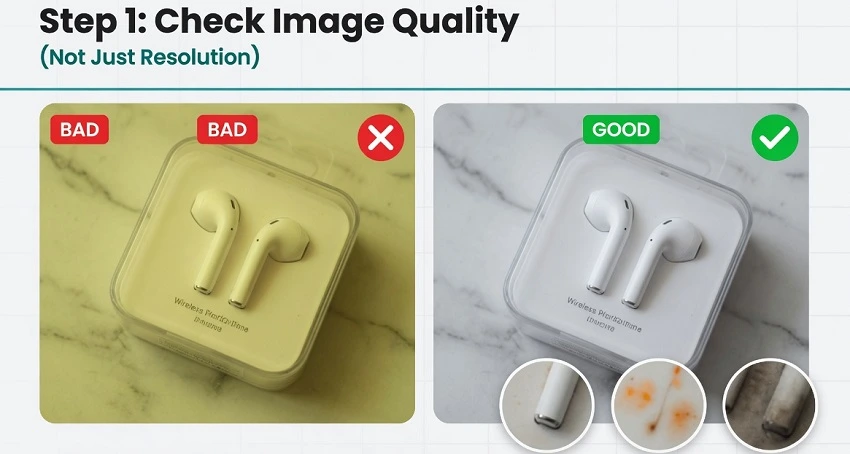
High resolution is not the same as high quality. You can have a 2000px image that still looks bad. Focus on:
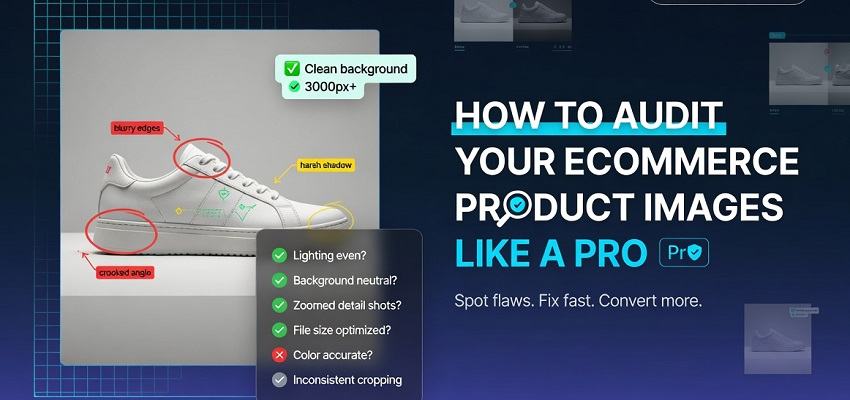
- Sharpness
- Lighting balance
- Color accuracy
- Noise or grain
- Natural appearance
Zoom into your images. Ask yourself:
Does the product still look clean and detailed? Or does it break apart? Common issues you’ll find:
- Blurry edges around products
- Overexposed highlights
- Harsh shadows
- Artificial color tones
If your product looks better in real life than in the image, your image is working against you.
Step 2: Evaluate Consistency Across Products
Consistency is one of the most underrated factors in ecommerce. Customers don’t view one product. They browse across multiple listings.
If every product looks different, your store feels disorganized. Check for:
- Background consistency (pure white, lifestyle, textured)
- Product alignment and spacing
- Camera angles
- Zoom level
Example: If one shirt is centered and another is slightly off, it creates friction. The customer may not notice consciously, but it affects perception.
Consistency builds confidence. It signals professionalism. Inconsistent visuals make your brand feel unreliable.
Step 3: Validate Product Accuracy
This step directly affects returns. Ask:
- Does the color match the real product?
- Does the texture look realistic?
- Are details clearly visible?
- Is anything exaggerated or misleading?
Many brands try to “enhance” images to make them more attractive. That’s a mistake.
A slightly brighter color might look appealing. But if it’s not accurate, customers feel misled.
That leads to returns, negative reviews, and long-term damage. Accuracy always wins over visual appeal.
Step 4: Review Image Types (Are You Showing Enough?)
Most ecommerce stores don’t provide enough visual information. One image is not enough to sell a product.
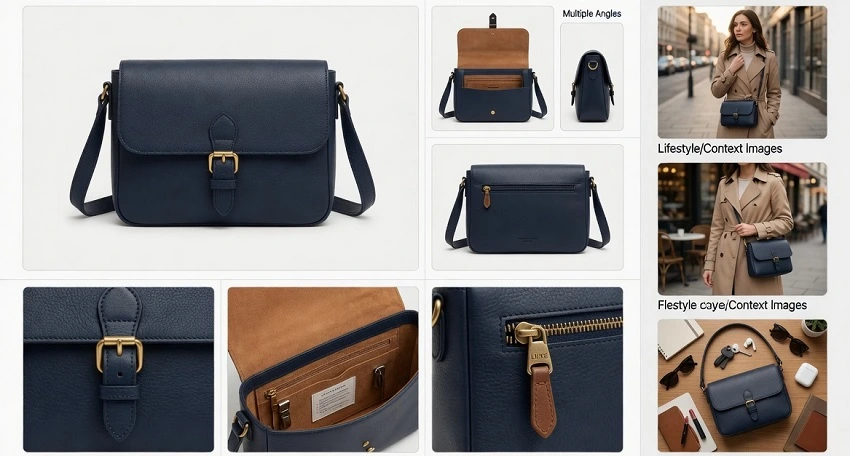
A professional product page typically includes:
- A main hero image
- Multiple angles (front, side, back)
- Close-up detail shots
- Lifestyle or context images
Each type serves a purpose. The hero image grabs attention. Angles provide clarity. Close-ups show quality. Lifestyle images build desire.
Ask yourself: Can a customer fully understand this product without reading the description?
If the answer is no, your image set is incomplete. Every missing image increases doubt.
Step 5: Analyze Conversion Readiness
This is where your audit becomes strategic. Stop thinking like a designer. Think like a buyer.
Ask:
- Does this image answer common customer questions?
- Does it show size, fit, or usage?
- Does it reduce hesitation?
Example: A handbag without a model gives no sense of scale. A chair without a room context feels abstract.
Your images should reduce thinking. If customers need to imagine too much, they leave.
Great product images don’t just show the product. They remove uncertainty.
Step 6: Check Mobile Optimization
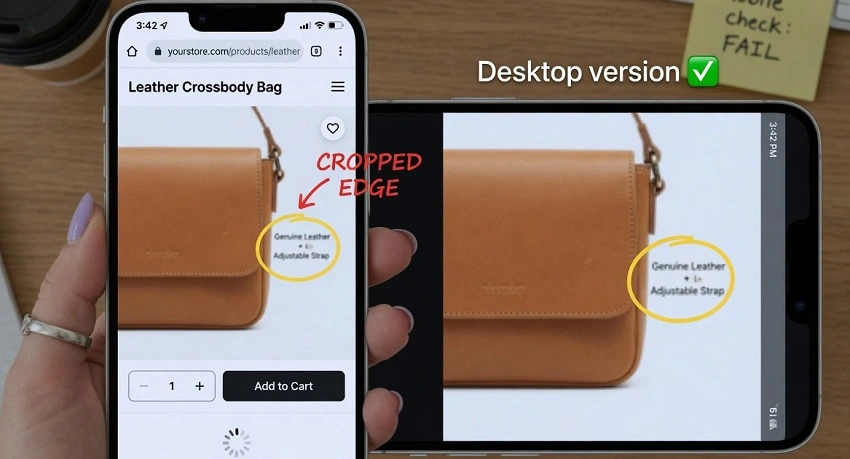
Most ecommerce traffic comes from mobile devices. But many images are still optimized for desktop viewing.
This creates problems. Check your site on a phone. Look for:
- Cropped product edges
- Important details getting cut off
- Poor clarity on small screens
- Slow loading due to large file sizes
Your product should be instantly recognizable on a small screen.
If a user needs to zoom in to understand what they’re looking at, you’ve already lost them.
Mobile clarity is not optional. It’s essential.
Step 7: Audit Image Load Speed & Performance
Speed affects revenue. Slow-loading images increase bounce rates and reduce conversions.
Check:
- File size (are images too large?)
- Image format (WebP vs JPEG/PNG)
- Compression level
- Lazy loading setup
Use tools like:
- Google PageSpeed Insights
- GTmetrix
Look for red flags:
- Large uncompressed images
- Too many images loading at once
- No performance optimization
Your goal is simple: Load fast without sacrificing quality.
Step 8: Check SEO & Metadata Optimization
This is often ignored. But image SEO can bring additional traffic and improve visibility in search. Check:
- File naming conventions
- Alt text descriptions
- Relevance to product keywords
Example:
Bad: IMG_2345.jpg Better: blue-running-shoes-side-view.jpg
Alt text should describe the image clearly and include relevant keywords naturally.
This helps:
- Search engines understand your content
- Accessibility for users
- Visibility in image-based search
If your images aren’t optimized, you’re missing an opportunity.
Step 9: Compare Against Competitors
Your customers compare options. You should do the same.
Identify your top competitors. Analyze:
- Image quality
- Number of images per product
- Variety of angles
- Use of models or environments
- Overall presentation
Then ask:
Where are they stronger? And more importantly: Where can you outperform them?
This step helps you move from “acceptable” to competitive.
Step 10: Review Workflow & Scalability
Most ecommerce brands struggle here. Not with quality. With consistency at scale.
Ask:
- How are images created?
- Who edits them?
- How long does the process take?
- Where are delays happening?
Common bottlenecks include:
- Manual editing overload
- Lack of clear guidelines
- No quality control system
- Slow turnaround times
As your catalog grows, these issues get worse. This is where a hybrid workflow (AI + human review) becomes useful.
AI can handle repetitive tasks quickly. Humans ensure quality and accuracy.
Without a scalable process, your visual quality will break as you grow.
Audit Scorecard (Simple Framework)
You don’t need complex tools. Create a simple scoring system from 1 to 5:
- Quality
- Consistency
- Accuracy
- Conversion readiness
- Speed
Then:
- Score each product or category
- Identify weak areas
- Prioritize improvements
Focus on:
- High-traffic products
- High-revenue products
That’s where small changes create the biggest impact.
Common Mistakes to Avoid
- Focusing only on visual appeal: Attractive images don’t always lead to sales. If they fail to answer customer questions or build trust, they can hurt conversions.
- Ignoring consistency across the catalog: Different styles, backgrounds, and angles can make your store seem unprofessional.
- Over-editing products: Bright colors or odd textures can seem appealing, but they often disappoint customers.
- Skipping mobile testing: Images that look fine on desktop can fail on mobile, where most users actually shop.
- Relying fully on AI without quality checks: AI can speed up editing. But without human review, errors and inconsistencies can slip through.
- Not updating old product images: As your brand grows, old images can lower quality and hurt how people see it.
FAQs
How often should I audit my ecommerce product images?
Every 3 to 6 months, or before major campaigns and product launches.
What is the most important factor in product images?
Consistency and accuracy matter more than just high resolution.
Can AI tools fully replace manual image audits?
No. AI can assist with speed, but human review is essential for quality control.
Do product images really affect sales performance?
Yes. They influence trust, clarity, and buying decisions directly.
What tools can help analyze image performance?
Tools like Google PageSpeed Insights can help identify speed and optimization issues.
To Conclude
Product images are not just design elements. They are your frontline sales tool.
Every image either builds trust or weakens it. The brands that win in ecommerce don’t just run better ads.
They present better visuals. A proper image audit helps you:
- Identify hidden conversion issues
- Improve customer trust
- Reduce returns
- Scale your catalog with consistency
And you don’t need a full redesign to see results. You just need to fix what’s already there.
Start with your top products. Run this audit. Make targeted improvements.
That’s how professionals approach ecommerce growth.